No answers to last week's trivia, again. The clue was:-
"The scientist, Emilie du Chatelet, is known as much for her relationship
with Voltaire as she is for her work in the field of physics; but the
famous couple once found themselves in a spot of trouble when in the
middle of a card game he told Emilie that he suspected some of the other
players of cheating. They didn't think anyone else would understand
their conversation, as they were speaking what language, not much in use
at the court of France?"
The answer was:- English! Unfortunately for the couple they weren't the only ones who spoke it, someone else did as well, and they were forced to flee court rather than suffer the violence offered by those who were offended by Voltaire's comment.
I've got a good one for you today!
This father and grandfather of two famous authors rose from a slave to a revered General in Revolutionary-era France, only to find himself betrayed and forgotten; yet lives on in the guise of at least one well-known character.
Bon chance!
The diary of an eighteenth century French noblewoman, and information relating to her world.
Showing posts with label Trivia. Show all posts
Friday, May 3, 2013
Tuesday, April 16, 2013
Trivia!
Was the question perhaps too easy? No one answered last week's trivia question, though the clue was in the picture.
"Which famous victim of the guillotine was described as the 'Ste Genvieve' of the royalists, and considered for sainthood herself?"
The answer is; Madame Elizabeth, sister of Louis XVI. Refusing to go into exile she saw it as her duty to remain by her brother's side through all of his misfortunes, and eventually followed him to the guillotine. Her insistence on keeping faith with her Catholic principles, and her desire to to encourage others even to the point of praying for them at the foot of the execution site, led to her consideration for sainthood. The people in charge of her execution group decided to enact one final cruelty by having her go last and watch all of the previous beheadings, but one by one those who preceded her stopped to ask her blessing before mounting the scaffold, and she herself walked to her death with immense poise; that is, until her fichu fell away. Madame Elizabeth said to the executioner, "For the love of your mother, cover me!" Those became her final words.
For this week I ask:- The scientist, Emilie du Chatelet, is known as much for her relationship with Voltaire as she is for her work in the field of physics; but the famous couple once found themselves in a spot of trouble when in the middle of a card game he told Emilie that he suspected some of the other players of cheating. They didn't think anyone else would understand their conversation, as they were speaking what language, not much in use at the court of France?
"Which famous victim of the guillotine was described as the 'Ste Genvieve' of the royalists, and considered for sainthood herself?"
The answer is; Madame Elizabeth, sister of Louis XVI. Refusing to go into exile she saw it as her duty to remain by her brother's side through all of his misfortunes, and eventually followed him to the guillotine. Her insistence on keeping faith with her Catholic principles, and her desire to to encourage others even to the point of praying for them at the foot of the execution site, led to her consideration for sainthood. The people in charge of her execution group decided to enact one final cruelty by having her go last and watch all of the previous beheadings, but one by one those who preceded her stopped to ask her blessing before mounting the scaffold, and she herself walked to her death with immense poise; that is, until her fichu fell away. Madame Elizabeth said to the executioner, "For the love of your mother, cover me!" Those became her final words.
For this week I ask:- The scientist, Emilie du Chatelet, is known as much for her relationship with Voltaire as she is for her work in the field of physics; but the famous couple once found themselves in a spot of trouble when in the middle of a card game he told Emilie that he suspected some of the other players of cheating. They didn't think anyone else would understand their conversation, as they were speaking what language, not much in use at the court of France?
Wednesday, April 3, 2013
Trivia!
It's been too long since we've done this. Last time I asked "What was the "fowl" name given to the pinkish hue of eighteenth-century champagne?"
A Traveller In Time correctly responded "Oeil de perdrix or partridge eye." Sounds yummy.
This week's question is an easy one:- Which famous victim of the guillotine was described as the "Ste Genvieve" of the royalists, and considered for sainthood herself?
A Traveller In Time correctly responded "Oeil de perdrix or partridge eye." Sounds yummy.
This week's question is an easy one:- Which famous victim of the guillotine was described as the "Ste Genvieve" of the royalists, and considered for sainthood herself?
Friday, March 8, 2013
Trivia!
Trivia returns with this festive question:- What was the "fowl" name given to the pinkish hue of eighteenth-century champagne?
Wednesday, December 26, 2012
Trivia
I seem to have stumped you a little bit with the most recent trivia question, although most probably it is just that everyone is too busy with holiday plans. I asked:-
"What manner of public conveyance in France could be used to travel for free, or very cheaply, so long as you were not in a hurry to get directly to a particular destination, and didn't mind traveling with some light, but bulky cargo?"
The answer: By mail coach.
I first came across this, not as an 18th century, but a 17th century occurance. In fact, the Mancini sisters famously used it to escape from their husbands, which is an intriguing story all by itself. Passengers sometimes found the conditions of travel by mail coach to be cleaner and more comfortable than travel by Diligence (public carriage). The cost was less than that of hiring a coach, but since it couldn't be determined just how many places the coach would need to stop your travel time could be slower than desired. Happily, if there were few letters to be delivered and the stops along the way had little mail to add, your trip could also be surprisingly short. There tended to be fewer people traveling by mail carriage, and (as they frequently included a guard) were less likely to be robbed.
I'm going to be pretty busy with plans of my own through the holidays, so no new trivia for now; but I want to wish everyone a very happy, safe, and fulfilling New Year!
"What manner of public conveyance in France could be used to travel for free, or very cheaply, so long as you were not in a hurry to get directly to a particular destination, and didn't mind traveling with some light, but bulky cargo?"
The answer: By mail coach.
I first came across this, not as an 18th century, but a 17th century occurance. In fact, the Mancini sisters famously used it to escape from their husbands, which is an intriguing story all by itself. Passengers sometimes found the conditions of travel by mail coach to be cleaner and more comfortable than travel by Diligence (public carriage). The cost was less than that of hiring a coach, but since it couldn't be determined just how many places the coach would need to stop your travel time could be slower than desired. Happily, if there were few letters to be delivered and the stops along the way had little mail to add, your trip could also be surprisingly short. There tended to be fewer people traveling by mail carriage, and (as they frequently included a guard) were less likely to be robbed.
I'm going to be pretty busy with plans of my own through the holidays, so no new trivia for now; but I want to wish everyone a very happy, safe, and fulfilling New Year!
Friday, December 21, 2012
Trivia!
Last week's question was:- "What french word came to describe all of the ex-aristocrats who fled France after the Revolution of 1789?"
A Traveller in Time correctly responded "Emigres."
Settling in places like Switzerland, Rome, England, and even America, these displaced aristrocrats were frequently despised by their host nations for their unwillingness to accept that life had changed. They were known for carrying on within their own communities very much as they had at home... until constraints of money forced them to do otherwise.
This week's question is:- What manner of public conveyance in France could be used to travel for free, or very cheaply, so long as you were not in a hurry to get directly to a particular destination, and didn't mind traveling with some light, but bulky cargo?
A Traveller in Time correctly responded "Emigres."
Settling in places like Switzerland, Rome, England, and even America, these displaced aristrocrats were frequently despised by their host nations for their unwillingness to accept that life had changed. They were known for carrying on within their own communities very much as they had at home... until constraints of money forced them to do otherwise.
This week's question is:- What manner of public conveyance in France could be used to travel for free, or very cheaply, so long as you were not in a hurry to get directly to a particular destination, and didn't mind traveling with some light, but bulky cargo?
Wednesday, December 12, 2012
Trivia!
Last time I asked:- This color became popular in the late eighteenth century, despite being named for a pest.
Lauren R managed to beat everyone else to the punch and correctly stated that it was "Puce" which we all know means "flea". There were actually several variations on the color, but traditionally it is held to be a sort of brownish-purple.
This week my query is:-
What french word came to describe all of the ex-aristocrats who fled France after the Revolution of 1789?
Lauren R managed to beat everyone else to the punch and correctly stated that it was "Puce" which we all know means "flea". There were actually several variations on the color, but traditionally it is held to be a sort of brownish-purple.
This week my query is:-
What french word came to describe all of the ex-aristocrats who fled France after the Revolution of 1789?
Sunday, November 18, 2012
Monday, May 7, 2012
Trivia Monday!
Alright, I told you this last one was hard. The question was "One of the Great Officers of the Crown of France died in 1782, leaving a
vacancy for his position that was never filled. What was the office
called? Extra credit for you if you can also name the decedent."
Despite some valiant efforts no one correctly guessed the answer, which was The Grand Panetier of France. Basically he was in charge of the Bread Department ("Panetier" is where we get the English word "Pantry"), but though this may sound like a lowly position it was not. Like many such royal charges, it was only given to noblemen, included the taxation and appropriation of all bread, and while it may have started out with overseeing the King's table, became largely ceremonial. In the 16th century the position of Panetier, as with many others at court, became hereditary, and was passed down within the Cosse de Brissac family. Though we know that the last incumbent died in 1782, there was at least one more member of the family alive (one who had, in fact, been Panetier at some point) so it is unclear why he did not take up the position again.
Time for something a little easier:- The eldest son of a Duke often held a title as heir to the duchy; for instance, the son of the Duke de Bouillon was known as "_ de Bouillon", what was the title?
Despite some valiant efforts no one correctly guessed the answer, which was The Grand Panetier of France. Basically he was in charge of the Bread Department ("Panetier" is where we get the English word "Pantry"), but though this may sound like a lowly position it was not. Like many such royal charges, it was only given to noblemen, included the taxation and appropriation of all bread, and while it may have started out with overseeing the King's table, became largely ceremonial. In the 16th century the position of Panetier, as with many others at court, became hereditary, and was passed down within the Cosse de Brissac family. Though we know that the last incumbent died in 1782, there was at least one more member of the family alive (one who had, in fact, been Panetier at some point) so it is unclear why he did not take up the position again.
Time for something a little easier:- The eldest son of a Duke often held a title as heir to the duchy; for instance, the son of the Duke de Bouillon was known as "_ de Bouillon", what was the title?
Monday, April 16, 2012
Trivia Monday!
What famous Brit said "Necessity is the plea of every infringement of human freedom. It is the argument of tyrants; it is the creed of slaves."?
Tuesday, March 27, 2012
Trivia Monday Answered
Last week's trivia question was:- Antoine Lavoisier, known as the "Father of modern chemistry", has been mentioned along with his wife in a few of the diary entries. What two elements is he famous for having "discovered", or at least named?
Banker Chick correctly responded "Hydrogen and Oxygen, though he was a chemist, he was executed during the French Revolution for being a tax collector."
Yes indeed, and for so much more. You see, Lavoisier was part of The Ferme, the powerful tax farmers of France, but his heart belonged to chemistry, and he even postulated the formula H2O for water. During the Revolution he successfully fought for freedom for foreign scientists trapped in France, but this, combined with the fact that he had once slighted the revolutionary firebrand Marat, meant that his fate was pretty much sealed. I mean, you just can't have someone who is powerful, wealthy, and intelligent getting his way and living to tell of it. He was executed by guillotine ostensibly for selling "watered down tobacco". Oh, the shame.
Though he was later exonerated after the Terror, I doubt it brought much comfort to his widow, who had tried vociferously to save her husband.
No additional trivia this week. I am going out of town on business and will only be able to post sporadically for the next few weeks. Catch you all on the flip side, and for those of you who come for the diary prepare for some interesting twists!
Banker Chick correctly responded "Hydrogen and Oxygen, though he was a chemist, he was executed during the French Revolution for being a tax collector."
Yes indeed, and for so much more. You see, Lavoisier was part of The Ferme, the powerful tax farmers of France, but his heart belonged to chemistry, and he even postulated the formula H2O for water. During the Revolution he successfully fought for freedom for foreign scientists trapped in France, but this, combined with the fact that he had once slighted the revolutionary firebrand Marat, meant that his fate was pretty much sealed. I mean, you just can't have someone who is powerful, wealthy, and intelligent getting his way and living to tell of it. He was executed by guillotine ostensibly for selling "watered down tobacco". Oh, the shame.
Though he was later exonerated after the Terror, I doubt it brought much comfort to his widow, who had tried vociferously to save her husband.
No additional trivia this week. I am going out of town on business and will only be able to post sporadically for the next few weeks. Catch you all on the flip side, and for those of you who come for the diary prepare for some interesting twists!
Tuesday, March 20, 2012
Trivia Monday...on Tuesday
Oops! I'm a little late in posting the trivia question for this week, my apologies. Last week's question was promptly answered by Susanne N. The question was:-
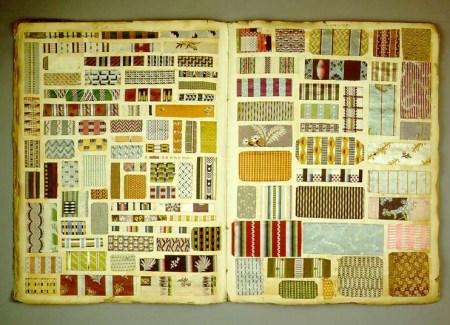
"We all know that Marie Antoinett's morning routine was strictly regulated by court ettiquette, but she did get to choose her clothing for the day. A card with swatches of the fabric for each outfit were brought to her, and she would do what to indicate her choice?"
Susanne's response was "She used pins to mark which clothes she liked to wear." Indeed. The swatchbook above, though not one of Marie Antoinette's, gives an idea of what hers looked like, and I have heard that at least a few pages have survived which show the pin pricks from where she indicated her choices.
And now for this week's question:-
Antoine Lavoisier, known as the "Father of modern chemistry", has been mentioned along with his wife in a few of the diary entries. What two elements is he famous for having "discovered", or at least named?
"We all know that Marie Antoinett's morning routine was strictly regulated by court ettiquette, but she did get to choose her clothing for the day. A card with swatches of the fabric for each outfit were brought to her, and she would do what to indicate her choice?"
Susanne's response was "She used pins to mark which clothes she liked to wear." Indeed. The swatchbook above, though not one of Marie Antoinette's, gives an idea of what hers looked like, and I have heard that at least a few pages have survived which show the pin pricks from where she indicated her choices.
And now for this week's question:-
Antoine Lavoisier, known as the "Father of modern chemistry", has been mentioned along with his wife in a few of the diary entries. What two elements is he famous for having "discovered", or at least named?
Monday, March 12, 2012
Trivia Monday!
It seems that I may have stumped you all last week. The question was "What style of dress was inspired by Beaumarchais' Marriage of Figaro?"
The answer:- Deshabille a la Suzanne! Named for the character of Figaro's sweetheart (and eventual wife) in the play, it consisted of a fitted jacket (similar to a perault), skirt, white apron, and fichu. I would also have given credit for the Costume au Grand Figaro, which is mentioned in a Galerie des Modes fashion plate.
The play was first officially performed in April of 1784, and had been heavily censored due mostly to the challenge it presented to the social order. Nevertheless it quickly became exceptionally popular inspiring, not only the two styles mentioned above, but also the Chapeau a la Basile, trimmings a la Figaro, and a Chapeau a la Cherubin. It's success led Mozart to compose his operatic version in 1786.
And now for this week's trivia question:-
We all know that Marie Antoinett's morning routine was strictly regulated by court ettiquette, but she did get to choose her clothing for the day. A card with swatches of the fabric for each outfit were brought to her, and she would do what to indicate her choice?
The answer:- Deshabille a la Suzanne! Named for the character of Figaro's sweetheart (and eventual wife) in the play, it consisted of a fitted jacket (similar to a perault), skirt, white apron, and fichu. I would also have given credit for the Costume au Grand Figaro, which is mentioned in a Galerie des Modes fashion plate.
The play was first officially performed in April of 1784, and had been heavily censored due mostly to the challenge it presented to the social order. Nevertheless it quickly became exceptionally popular inspiring, not only the two styles mentioned above, but also the Chapeau a la Basile, trimmings a la Figaro, and a Chapeau a la Cherubin. It's success led Mozart to compose his operatic version in 1786.
And now for this week's trivia question:-
We all know that Marie Antoinett's morning routine was strictly regulated by court ettiquette, but she did get to choose her clothing for the day. A card with swatches of the fabric for each outfit were brought to her, and she would do what to indicate her choice?
Sunday, March 4, 2012
Trivia Monday!
Congratulations to Banker Chick who correctly answered last week's trivia question! There was a vast miniature palace and town commissioned by Princess Dorothea of Schwarzburg-Arnstadt in the 18th century. What was the name of that grand project?
The answer: Mon Plaisir! I have been fascinated by this tiny recreation of life both in and outside of the Prince's court, ever since I was very young. The Prince and Princess are themselves depicted in several rooms, as are some of their favorite courtiers, but everyone from nuns to maids to chimney sweeps are rendered in loving detail. For a plethora of beautiful images of the collection I strongly recommend checking out this video:-
You can also find out more about it in the book The Miniature House.
And now for this week's trivia question:-
What style of dress was inspired by Beaumarchais' Marriage of Figaro? Extra points if you can tell me what features distinguish it from other styles.
The answer: Mon Plaisir! I have been fascinated by this tiny recreation of life both in and outside of the Prince's court, ever since I was very young. The Prince and Princess are themselves depicted in several rooms, as are some of their favorite courtiers, but everyone from nuns to maids to chimney sweeps are rendered in loving detail. For a plethora of beautiful images of the collection I strongly recommend checking out this video:-
You can also find out more about it in the book The Miniature House.
And now for this week's trivia question:-
What style of dress was inspired by Beaumarchais' Marriage of Figaro? Extra points if you can tell me what features distinguish it from other styles.
Tuesday, February 28, 2012
Trivia Monday!
Augustintytär was the first to correctly guess the answer to last week's trivia question "This novel, published in 1782, was immensely popular in it's day and caused quite a stir for the licentious behavior depicted. It remains popular to this day, and has been made into plays, movies, and even an opera."
The answer, as many of you know, was Dangerous Liasons.
Banker Chick pointed out that there tends to be a French theme to the questions, which is pretty true but this week features a blend of French and German:-
There was a vast miniature palace and town commissioned by Princess Dorothea of Schwarzburg-Arnstadt in the 18th century. What was the name of that grand project?
The answer, as many of you know, was Dangerous Liasons.
Banker Chick pointed out that there tends to be a French theme to the questions, which is pretty true but this week features a blend of French and German:-
There was a vast miniature palace and town commissioned by Princess Dorothea of Schwarzburg-Arnstadt in the 18th century. What was the name of that grand project?
Monday, February 20, 2012
Trivia Monday!
Despite good guesses from some of you, no one was able to correctly answer our trivia question from last week. Ready for the answer? "What historical figure had several pets, including a monkey, birds, and small dogs (two of whom were named Mimi and Ines)?"
It was Mme de Pompadour! Louis XV's favorite mistress was painted several times with her precious pets, perhaps as a symbol of her fidelity to her lover and King, or simply out of fondness for the creatures. Too bad we don't know which little Papillion is being depicted in the painting, as he climbs up to peek curiously at her needlework and beg for attention. My own canine companion, Reinette, was named after the Maitress-en-titre herself.
So onto this week's trivia question:- This novel, published in 1782, was immensely popular in it's day and caused quite a stir for the licentious behavior depicted. It remains popular to this day, and has been made into plays, movies, and even an opera.
It was Mme de Pompadour! Louis XV's favorite mistress was painted several times with her precious pets, perhaps as a symbol of her fidelity to her lover and King, or simply out of fondness for the creatures. Too bad we don't know which little Papillion is being depicted in the painting, as he climbs up to peek curiously at her needlework and beg for attention. My own canine companion, Reinette, was named after the Maitress-en-titre herself.
So onto this week's trivia question:- This novel, published in 1782, was immensely popular in it's day and caused quite a stir for the licentious behavior depicted. It remains popular to this day, and has been made into plays, movies, and even an opera.
Monday, February 13, 2012
Trivia Monday!
I've decided it would be fun to start to a new blog feature. Every Monday I will post a trivia question related to the 18th century, and the first person to leave a comment with the correct answer will have their name and response posted the following week.
I have a pretty easy one for you this week:-
What historical figure had several pets, including a monkey, birds, and small dogs (two of whom were named Mimi and Ines)?
I have a pretty easy one for you this week:-
What historical figure had several pets, including a monkey, birds, and small dogs (two of whom were named Mimi and Ines)?
Subscribe to:
Posts (Atom)
For Your Chateau
With another successful Fetes Galante complete at the Chateau de Versailles, I thought we'd have a Versailles-themed FYC. Enjoy this d...
-
I owe you all I good post, not only because I have been so remiss in updating lately, but because I am likely to remain a little less prolif...
-
During the uprising of the Vendee when royalists in southern France clashed with the French Republic troops, the young (royalist) general He...
-
With another successful Fetes Galante complete at the Chateau de Versailles, I thought we'd have a Versailles-themed FYC. Enjoy this d...