The diary of an eighteenth century French noblewoman, and information relating to her world.
Saturday, November 7, 2020
Tuesday, September 8, 2020
18th Century Textiles and the Eden Agreement
I'm a university professor and my specialty is in the area of Costume and Identity, which is heavily expressed through an interest in textiles and clothing of the past. I mentioned in the most recent Diary entry that there was a treaty being worked out between France and Great Britain primarily having to do with tariffs on items between the two countries. Our narrator may not have much faith in the treaty being worked out, but historically it was in September of 1786 and is know as the Eden Agreement. Both countries were suffering in the aftermath of the American Revolutionary War, England and France having lost colonies and suffered severe financial hits, with huge losses to Black Market profiteers. The idea was for each country to give preferential treatment in taxes and tariffs to goods from the other, so that more legal trade would occur and increase the pecuniary fortunes of their respective governments.
Alcohol, particularly wines, were a big part of this, but also olive oil and fabrics and fibers like wool, cotton, and cambric, and French millinery. So the French were supposed to buy more English cottons instead of Indiennes manufactured in (you guessed it) India, and the English were supposed to buy more French hats. Did it work out that way? Not exactly. The Black Market trade was still cheaper than paying any tax at all, and public preference didn't necessary follow the official line either.
It's a fascinating look at not only commercial interests, but cultural attitudes as well, since both countries recognized the potential mutual beneficence, and yet felt threatened by the others' goods whether they saw them as cheap industrial versions that had the potential to replace traditional handicraft (a fear ironically expressed from each to each), or simply wanted to maintain the weakness of their "arch enemy". In England the prominent Whig politician Charles James Fox felt that such a treaty would undermine the absolute duty of England to keep France in check in Europe; while his opponent, the Tory Prime Minister William Pitt the Younger, was of the opinion that there were no need for continued and "eternal" opposition between the countries when the treaty might re-stabilize both parties.
Unfortunately it wasn't only the English politicians who had strong feelings about the results. While some English manufacturing organizations and guilds wrote and disbursed their support and dissentions respective of their trade, in France the reaction was downright violent in some areas, with textile manufacturers in Normandy and Bordeaux seeing rioting and destruction in response to the idea that it would lead to the loss of French jobs as cheaper British goods flooded the market. Nor were they entirely wrong, as textiles jobs did see a large downturn in the years immediately following the Treaty which, combined with a poor harvest in 1788, would all become part of the distress leading up to the French Revolution.
Friday, May 23, 2014
The costuming bug bites
Nevertheless, I invite you to share in my distraction while I indulge in some of my favorite inspirations...
![]() |
| Princesse de Lamballe |
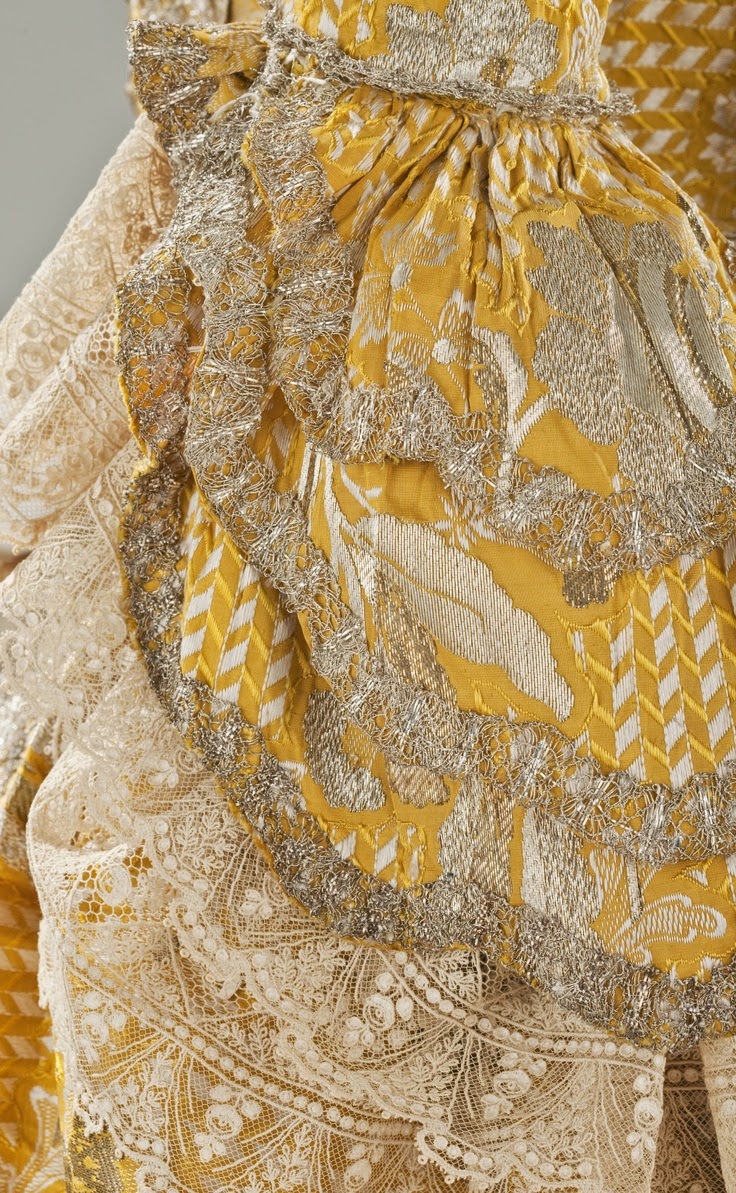
Speaking of sleeves, these ones from c.1760 have a really interesting lace pattern, gilt trim, and the scalloped edge that give them that wow-factor I know I'm drawn to.
I'm also drawn to this 1750s court dress, and the way the passementerie is really large at the front edges of the skirt, and then scaled back on the bodice. I'm a small woman, so large trims can overpower me if I'm not careful. Someday I will have a court dress like this, but that is not this project. Must stay focused!
It's the way the back pleats appear to hang off of the neckline trim on this 1775-80 ivory moire silk. There's a simple beauty to that which I cannot help wanting to recreate.
Finally, though this c.1780 sage gown is a different style, I think the color combination would be stunning with some taupe and gilt trim. It would also go with my sage-colored Georgianas from American Duchess.
Surely I can squeeze this project in, right? Maybe with a coordinating Bergere?
Wednesday, October 12, 2011
Historical Influence in Fashion

Monday, October 3, 2011
Know Your Clothes (and Accessories)- The Quizzing Glass
"A monocle dangling from a neck-chain- a very fashionable accessory; in the 1820's dandies often had the glass fixed into the head of their canes." - The Dictionary of Fashion History
Used by men and women alike from about the 1790s , it often came attached to a small handle which terminated in a loop, thus allowing it to be strung on a chain or ribbon. It's exactly the kind of thing you can see Sir Percy Blakeney use, when he's not being The Scarlet Pimpernel!
For Your Chateau
With another successful Fetes Galante complete at the Chateau de Versailles, I thought we'd have a Versailles-themed FYC. Enjoy this d...
-
I owe you all I good post, not only because I have been so remiss in updating lately, but because I am likely to remain a little less prolif...
-
During the uprising of the Vendee when royalists in southern France clashed with the French Republic troops, the young (royalist) general He...
-
With another successful Fetes Galante complete at the Chateau de Versailles, I thought we'd have a Versailles-themed FYC. Enjoy this d...